
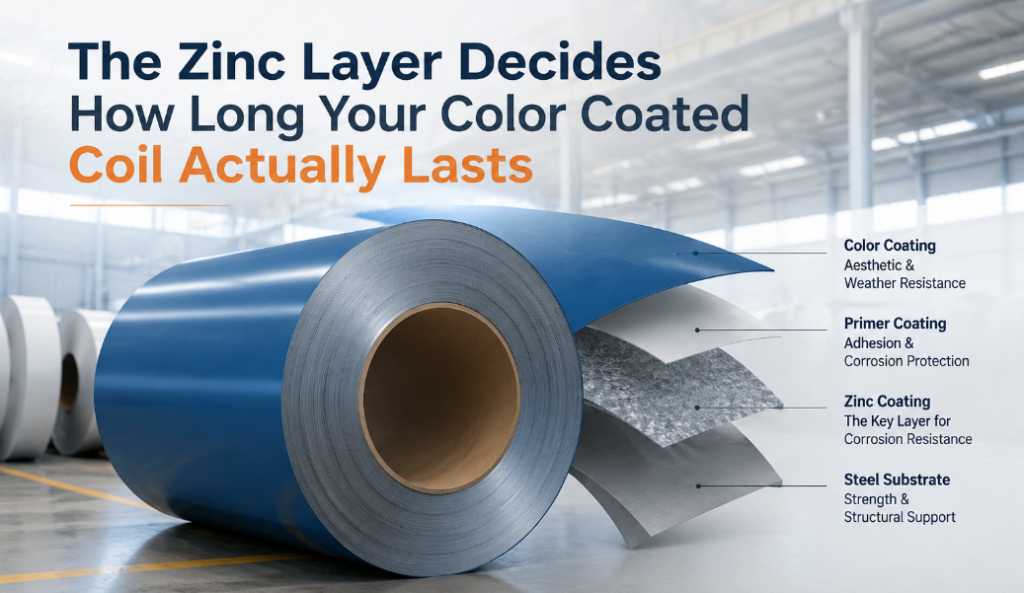
Buyers shopping for premium color coated coil almost always start with the color chart and the paint system. Few start where the real service life is decided: the zinc layer sitting underneath, doing the corrosion-fighting work long after the paint film has been scratched, chalked, or worn through at an edge or fastener hole. Paint protects appearance. Zinc protects the steel. This article looks at what’s actually happening beneath the color.
Why the Substrate Matters More Than the Paint, Long-Term
Paint film is a barrier coating — it works by physically blocking moisture and oxygen from reaching the steel. But every barrier coating eventually gets breached: a scratch during installation, a drilled fastener hole, a cut edge at a panel joint, weathering-induced micro-cracking after a decade of UV exposure. The moment that happens, whatever’s beneath the paint is the only thing standing between exposed steel and corrosion.
This is why the zinc (or zinc-alloy) coating underneath premium color coated coil isn’t a secondary spec — it’s the layer that determines what happens after the paint’s protection is compromised, which for any coil with a real-world service life, is a question of when, not if.
Galvanic Protection: What the Zinc Layer Is Actually Doing
Zinc protects steel through galvanic action. Zinc is less noble than iron on the galvanic series, meaning when both are exposed to moisture at a scratch or cut edge, zinc corrodes preferentially — sacrificing itself to protect the steel underneath. This is what allows a scratched galvanized panel to self-heal at small defect points, something a pure paint barrier coating cannot do on its own.
The thickness of that zinc layer directly determines how long this sacrificial protection lasts. A thin coating exhausts its galvanic protection faster; a heavier coating keeps protecting the cut edge or scratch for years longer.
Zinc Coating Weight Classes and What They Mean
| Coating Class | Zinc Weight (both sides) | Expected Performance Context |
|---|---|---|
| Z60 – Z100 | 60–100 g/m² | Light protection, short design life, indoor-adjacent use |
| Z120 – Z180 | 120–180 g/m² | Standard commercial roofing in moderate climates |
| Z200 – Z275 | 200–275 g/m² | Extended-life roofing and cladding, typical premium PPGI baseline |
| Z350+ | 350 g/m² and above | Heavy industrial or coastal-adjacent applications requiring maximum galvanic reserve |
For color coated coil marketed as “premium,” Z200 or higher is generally the minimum worth specifying — anything lighter puts most of the long-term protection burden entirely on a paint film that will eventually be compromised somewhere across a large roof or facade surface.
Zinc-Aluminum-Magnesium (ZAM/Super Dyma) Coatings
A newer generation of substrate coating adds magnesium and higher aluminum content to the traditional zinc bath — typically around 6% aluminum, 3% magnesium, and the balance zinc. In salt spray and cut-edge corrosion testing, ZAM-type coatings have shown corrosion resistance several multiples beyond standard hot-dip galvanizing at equivalent coating weight, largely due to magnesium’s role in forming a more stable, less porous corrosion product layer at the cut edge.
For buyers specifying color coated coil for coastal, industrial, or high-corrosion environments, ZAM-coated substrate — even at a lower nominal coating weight than standard Z275 — can outperform standard galvanized substrate at higher weight, though it comes at a cost premium and is less universally available across mills.
PPGL: Where Aluminum Changes the Corrosion Mechanism
Galvalume/Aluminum-Zinc alloy coated substrate (typically 55% Al / 43.5% Zn / 1.5% Si) shifts the protection mechanism from purely galvanic to a combination of barrier and galvanic protection. The aluminum content forms a stable, passive oxide layer — similar in principle to how stainless steel resists corrosion — while the zinc portion still provides some sacrificial protection at cut edges, though less than pure zinc coating provides.
The practical result: PPGL substrate typically outperforms PPGI on flat surface corrosion resistance, but PPGI can offer better protection specifically at cut edges and fastener penetrations, where galvanic action matters most. This is a genuine trade-off, not a simple “PPGL is always better” answer, and the right choice depends on whether a project involves significant field cutting and fastening versus large uninterrupted panel runs.
How Coating Weight Is Actually Verified
A number on a data sheet only means something if it’s independently verifiable. Legitimate coating weight verification methods include:
- Triple-spot test (ASTM A90) — stripping the coating from sample points and weighing the mass loss, giving a direct gravimetric measurement
- Magnetic thickness gauging — a faster, non-destructive field method, though less precise than gravimetric testing
- X-ray fluorescence (XRF) — increasingly used for rapid, non-destructive coating composition and thickness verification on production lines
Buyers ordering premium color coated coil in volume should request coating weight test data specific to their production batch, not a generic specification sheet — coating weight can vary meaningfully between production runs even from the same mill.
Standard Specifications
| Specification | Range |
|---|---|
| Substrate options | Galvanized (PPGI), Galvalume/AZ (PPGL), ZAM/Zn-Al-Mg |
| Zinc coating weight | Z60 – Z600 |
| AZ coating weight | AZ50 – AZ150 |
| Base metal thickness | 0.13mm – 1.2mm |
| Topcoat systems | PE, SMP, HDP, PVDF |
| Standards | ASTM A653 (zinc), ASTM A792 (AZ), EN 10346 |
Questions to Ask Before Specifying the Substrate
- What coating weight class is the base substrate rated at, and is that confirmed by triple-spot test data or only a nominal spec?
- For coastal or high-humidity destinations, has the supplier compared PPGI, PPGL, and ZAM options with actual salt spray test data rather than general claims?
- Does the coating weight apply to both sides of the coil, or is it a combined/single-side figure that effectively halves the per-side protection?
- For cut edges and fastener holes — the weakest points in any coated panel — what specific protection does the chosen substrate provide, and does that match the project’s fastening and field-cutting requirements?
The Layer That Does the Long-Term Work
A color chart tells you what a roof or facade will look like on installation day. The zinc layer underneath tells you what it will look like — and how well it will hold up structurally — fifteen years later, after the first scratch, the first drilled hole, the first decade of weather has had its say. Specifying substrate coating weight and type with the same rigor buyers usually reserve for paint systems is what actually protects a project once the surface finish stops being the only thing standing between the steel and the elements.
For coating weight test data, substrate comparisons, or a quotation matched to your project’s environmental exposure, our export team can help specify the right substrate for your application.