
In structural engineering, concrete possesses excellent compressive strength but lacks the ability to withstand significant tension. Deformed steel rebar (reinforcing bar) acts as the critical tension-resisting skeleton in reinforced concrete structures. For structural engineers, EPC contractors, and global procurement teams, evaluating rebar goes far beyond diameter and weight; it requires a deep understanding of metallurgy, rib geometry, and seismic ductility.
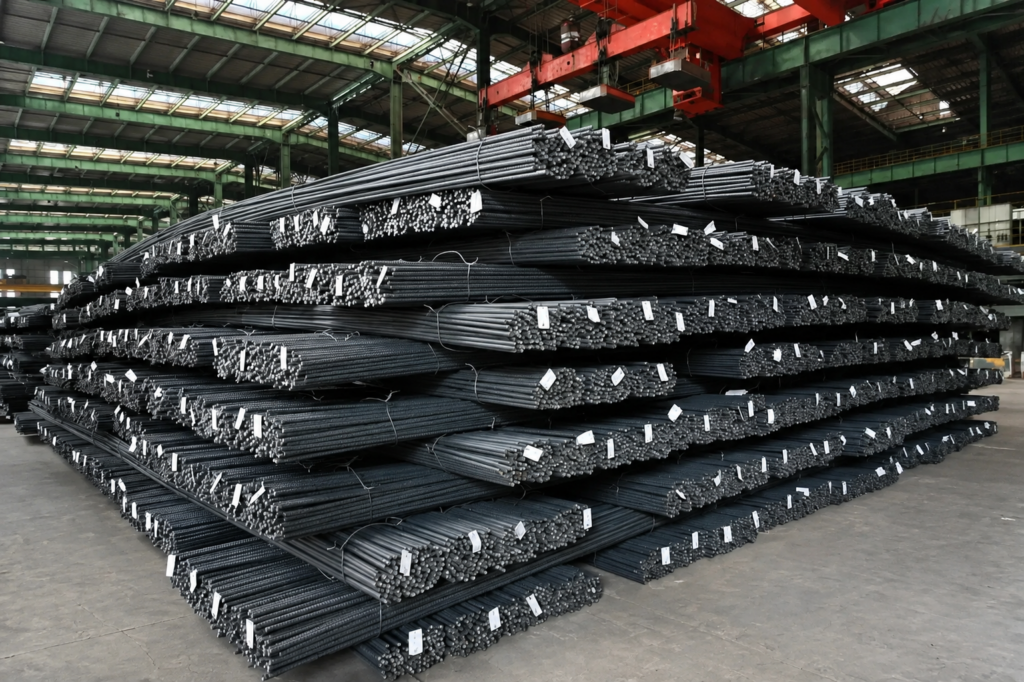
1. Metallurgical Processing: The TMT (Thermo-Mechanical Treatment) Advantage
Modern high-strength rebars are predominantly manufactured using the TMT (Thermo-Mechanically Treated) or Tempcore process. This advanced metallurgical technique eliminates the need for expensive alloying elements (like Vanadium or Micro-alloying) while achieving superior strength and flexibility.
The process involves rapid water quenching of the hot-rolled bar, followed by atmospheric cooling. This creates a highly engineered composite microstructure across the cross-section:
- Outer Ring (Tempered Martensite): The rapid cooling hardens the outer layer, providing the rebar with high yield strength and excellent wear resistance.
- Inner Core (Ferrite-Pearlite): The slow-cooling core remains highly ductile and tough.
This dual-structure allows TMT rebars to easily bend without surface fracturing—a critical requirement for complex structural cages and seismic energy dissipation.
2. Rib Geometry and Mechanical Bonding
The surface deformations (ribs) on a rebar are not merely for aesthetics; they are heavily regulated by international standards (e.g., ISO 6935-2, ASTM A615). The geometry directly dictates the mechanical interlock (bond strength) between the steel and the surrounding concrete matrix.
- Transverse Ribs: These angular ridges prevent longitudinal slip when the concrete structure is placed under heavy tension or bending moments. The angle and height of these ribs are optimized to maximize load transfer without creating localized stress concentrations that could crack the concrete.
- Longitudinal Ribs: These run parallel to the axis of the bar and are formed by the gap between the roll-forming dies during manufacturing.
Engineering Note: To pass rigorous pull-out tests, the specific projected rib area ($f_R$) must meet stringent minimum values dictated by building codes to ensure zero slippage during dynamic loading.
3. Global Grades and Seismic Ductility (Yield to Tensile Ratio)
When specifying rebar for high-rise buildings, bridges, or earthquake-prone zones, the Yield Strength ($R_e$) and Ultimate Tensile Strength ($R_m$) are paramount.
| Standard / Grade | Minimum Yield Strength | Application Profile |
| ASTM A615 Grade 60 | 420 MPa | Standard commercial and residential construction in North America and standard international projects. |
| BS 4449 Grade B500B / B500C | 500 MPa | High-stress European and Middle Eastern structures. ‘C’ class denotes supreme seismic ductility. |
| JIS G3112 SD400 / SD500 | 400 / 500 MPa | Widely used in Asian markets; highly optimized for earthquake resistance. |
A critical metric for seismic zones is the $R_m / R_e$ ratio (the ratio of ultimate tensile strength to yield strength). A higher ratio (e.g., $\ge 1.15$) ensures that before the steel completely snaps under extreme stress (like an earthquake), it will undergo significant plastic deformation, providing visible warning signs and preventing catastrophic sudden building collapse.
At SDY Steel Manufacturer, we produce premium TMT deformed rebars that strictly comply with ASTM, BS, and JIS standards. Whether you require standard 12mm bars for residential foundations or heavy-duty 40mm B500C rebars for civil infrastructure, our quality control ensures exceptional metallurgical consistency and bonding performance. Contact our engineering sales team today to request a quote or detailed mill test certificates (MTC) for your next project.