
Scaffolding is one of those products where the difference between a good supplier and a bad one shows up at the worst possible moment — mid-project, mid-height, with workers standing on it. For contractors and rental yards sourcing scaffolding internationally, getting the system, coating, and load rating right matters more than almost any other steel product in the catalog.
What Steel Scaffolding Is Made Of
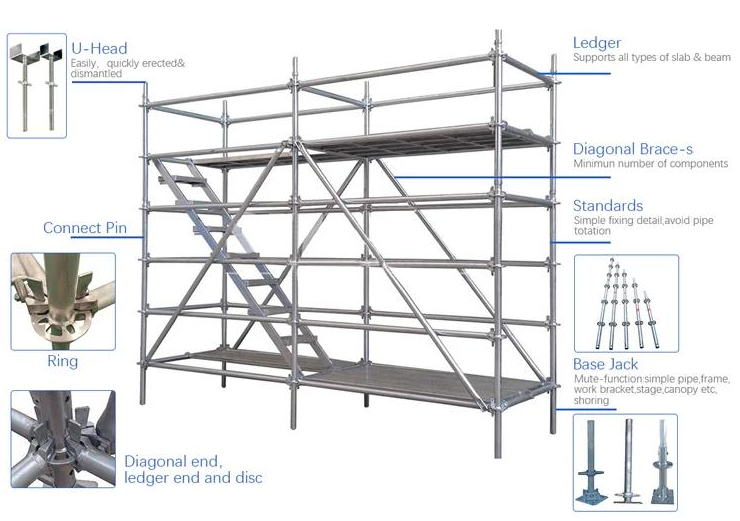
Most export scaffolding is built from hot-dip galvanized steel tube, formed into standards (verticals), ledgers (horizontals), and diagonal braces, then joined using one of several connection systems. The galvanizing isn’t optional for outdoor or long-term rental use — scaffolding sits exposed to weather for the full duration of a project, and uncoated steel starts rusting at the exact joints where structural integrity matters most.
The Main Scaffolding Systems
Cuplock Scaffolding Uses a rotating cup mechanism welded to the vertical standard, allowing up to four horizontal members to connect at a single node. Fast to assemble, strong under load, and widely used for large-scale construction and shoring applications.
Ringlock Scaffolding Similar concept to cuplock but uses a rosette plate with slots, offering a slightly more versatile connection angle. Popular in European and Middle Eastern markets, and well suited to complex or curved structures.
Kwikstage Scaffolding A wedge-and-pin connection system favored in Australia, the UK, and parts of Africa for its speed of assembly and lower component count.
Tube and Coupler (Traditional) Scaffolding The most flexible system — plain scaffold tube joined with separate couplers — used where irregular shapes or non-standard layouts are needed.
Frame Scaffolding (H-Frame / Door-Frame) Prefabricated frame sections that stack vertically, common for facade work and lighter-duty applications where speed matters more than configurability.
Standard Specifications
| Component | Typical Specification |
|---|---|
| Tube outer diameter | 48.3mm (standard), 48.6mm |
| Wall thickness | 2.5mm – 3.5mm |
| Steel grade | Q235, Q345 |
| Coating | Hot-dip galvanized, 275–600 g/m² |
| Standard lengths | 0.5m – 3.0m (verticals and ledgers) |
| Load class | Light duty to heavy duty, per EN 12811 or BS 1139 |
| Standards | EN 12810, EN 12811, BS 1139, AS/NZS 1576 |
Component dimensions vary slightly by manufacturer and system type, so cross-compatibility between brands should never be assumed — mixing components from different suppliers is one of the most common causes of site accidents.
Why Galvanizing Quality Is Non-Negotiable Here
Scaffolding gets disassembled, stacked, transported, and reassembled dozens or hundreds of times over its working life. Every one of those cycles puts stress on joints and connection points — exactly where a thin or uneven zinc coating fails first. A scaffold tube that looks fine in the yard can already have corrosion starting inside a cup joint or coupler thread after a few damp seasons of use.
This is why load-bearing components deserve heavier coating specifications than general construction steel, and why buyers should ask specifically about coating thickness at weld points and joints, not just the average across the tube body.
Where Scaffolding Gets Used
- Building construction — facade access, formwork support, and general site scaffolding
- Industrial maintenance — refinery, power plant, and shipyard shutdown work
- Events and staging — temporary structures for concerts, exhibitions, and sports events
- Shoring and shuttering — support during concrete pours and excavation work
- Rental fleets — scaffolding companies building out inventory for hire across multiple job types
Documentation and Testing to Ask For
- Mill Test Certificate (MTC) confirming steel grade and mechanical properties
- Load test certificates for cuplock nodes, ringlock rosettes, or coupler joints
- Compliance certification against the standard your market requires (EN 12810/12811 for Europe, BS 1139 for UK-influenced markets, AS/NZS 1576 for Australia)
- Galvanizing coating weight reports, ideally covering joint and weld areas specifically
- Third-party inspection (SGS, BV) before shipment, especially for large rental fleet orders
Questions Worth Asking a Scaffolding Supplier
- Do their cups, rosettes, or wedges match an established system exactly, or are they a “compatible” copy that may not interlock reliably with existing stock?
- What’s the coating weight at the joint welds specifically, not just the tube body average?
- Can they supply load test data for the connection system, not just the raw tube?
- How do they pack scaffolding for export — bundled by component type, with node protection to prevent damage in transit?
Getting Scaffolding Right From the Start
Scaffolding isn’t a product where “close enough” specifications are acceptable — the load path runs through every joint, weld, and coupling, and a weak point anywhere in that chain is a safety issue, not just a quality one. Matching the right system to your market’s standards, confirming coating quality at the joints, and working with a supplier who can back up their claims with test certificates makes the difference between a scaffold that performs for a decade and one that becomes a liability.
If you’re sourcing scaffolding for a construction project or building out rental inventory, our export team can help match the right system, coating spec, and standard to your target market.