For industrial and commercial construction, specifying color-coated corrugated sheets (PPGI/PPGL) is a precise engineering decision. Beyond aesthetic appeal, these profiled metal sheets must function as a durable building envelope, resisting complex dynamic loads, aggressive environmental corrosives, and thermal stress over decades of service.
1. Wind Uplift Resistance and Load Capacity
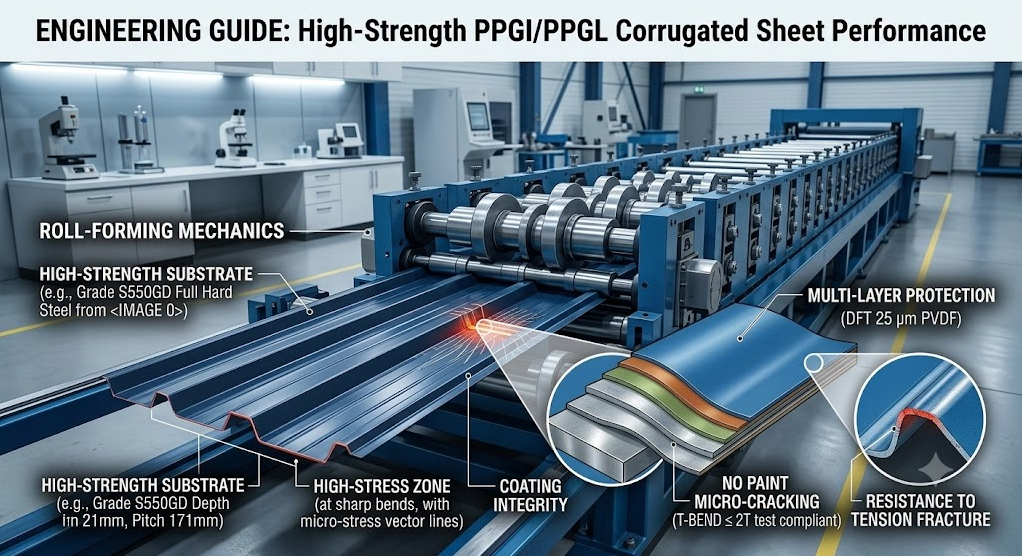
The structural integrity of a corrugated metal roof is largely determined by its profile geometry combined with the base metal’s mechanical properties. When evaluating a sheet for high wind zones or heavy snow loads, engineers must consider the Section Modulus (Z) and Moment of Inertia (I) of the profile.
- Rib Height to Pitch Ratio: Trapezoidal profiles with deeper ribs (e.g., 35mm to 50mm) significantly increase the spanning capacity of the sheet, allowing for wider purlin spacing without compromising structural stability.
- Fastening Mechanics: The resistance to wind uplift relies on the interaction between the fastener, the EPDM sealing washer, and the steel substrate. Using high-tensile steel (like Grade 80 / G550) minimizes localized deformation around the screw hole, preventing fastener pull-through during extreme weather events.
2. Cut-Edge Protection and Galvanic Action
One of the most critical failure points in any pre-painted metal roofing system is the exposed cut edge. When sheets are sheared to length on-site, the raw steel substrate is exposed to the elements.
- Cathodic Protection: High-quality PPGI (Zinc-coated) and PPGL (Aluminum-Zinc coated) sheets utilize a galvanic process to protect these edges. The zinc in the metallic coating is more electrochemically active than the steel. When exposed to moisture, the zinc acts as a sacrificial anode, oxidizing first and forming a protective barrier over the exposed steel edge, actively preventing red rust creepage beneath the paint layer.
- Aluzinc Advantage: In PPGL sheets, the aluminum matrix provides a stable, long-term barrier, while the zinc-rich areas provide the necessary sacrificial protection, making it superior for aggressive marine environments.
3. Thermal Reflectivity and SRI (Solar Reflectance Index)
Modern color-coated corrugated sheets play a vital role in a building’s energy efficiency. The choice of the topcoat paint system directly impacts the Solar Reflectance Index (SRI), which measures the roof’s ability to reject solar heat.
| Paint Pigment Technology | Thermal Performance | Application |
| Standard Pigments | Absorbs high levels of near-infrared (NIR) radiation. High heat transfer. | Standard industrial sheds, unconditioned spaces. |
| Cool Roof / NIR Reflective | Reflects NIR radiation even in dark colors. Lowers roof surface temperature by up to 15°C. | Cold storage facilities, green building certified projects (LEED). |
Technical Takeaway: Selecting a PVDF or highly formulated HDP coating with infrared-reflective pigments not only reduces HVAC cooling loads but also extends the lifespan of the coating itself by reducing thermal expansion and contraction cycles that lead to paint fatigue.
At SDY Steel Manufacturer, we engineer our color-coated corrugated sheets to exact structural and environmental tolerances. From calculating optimal purlin spans to formulating customized cool-roof paint systems, we provide comprehensive technical support for your procurement needs. Contact our engineering team to request sample panels and detailed load-span tables for your next project.